Tee sheet

Golf Tee Sheet Software

Most golf tee sheet software is sold as a concept — a calendar, a grid, “streamlined bookings”. The parts that decide whether a morning runs well are the ones nobody shows you: what happens when a single and a threesome book the same slot separately, what a junior costs when three other player types are in the same foursome, and what the starter sees when a tournament is holding nine o’clock. So here is the actual sheet, with those answers on it.
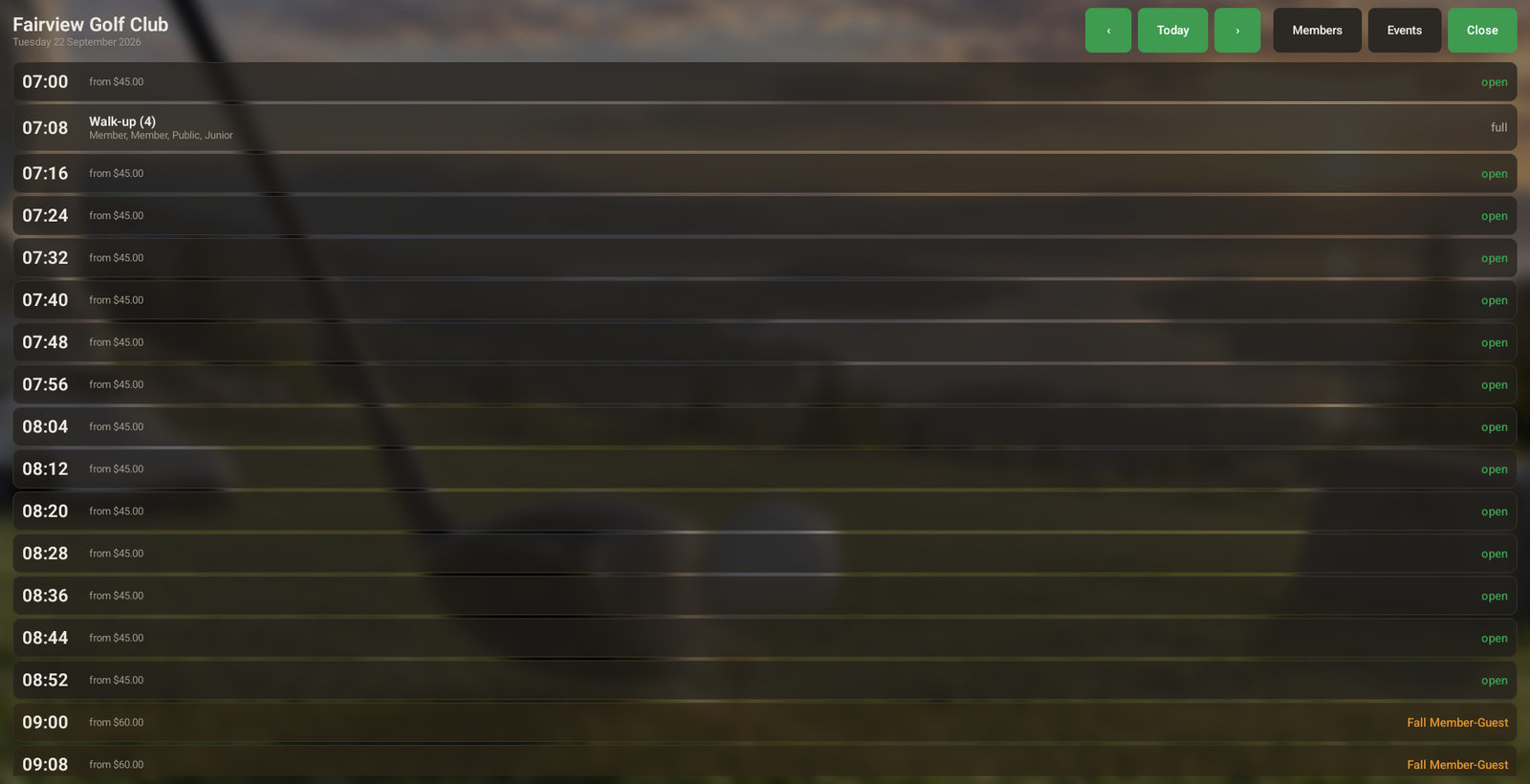
The MulliganOS tee sheet for Tuesday 22 September: eight-minute tee times from seven o’clock, a full walk-up foursome at 07:08, and the Fall Member-Guest holding every time from nine o’clock at the higher rate

One real day at the demo course. Eight-minute tee times from 07:00, a walk-up foursome at 07:08 reading full, and the Fall Member–Guest holding every time from 09:00 — where the price also steps from $45 to $60 because the rate card says so, not because someone remembered to change it.
How it actually works

Three screens that decide your morning

Everything below is a screenshot of the running system, not a rendering. Prices shown are Canadian dollars.

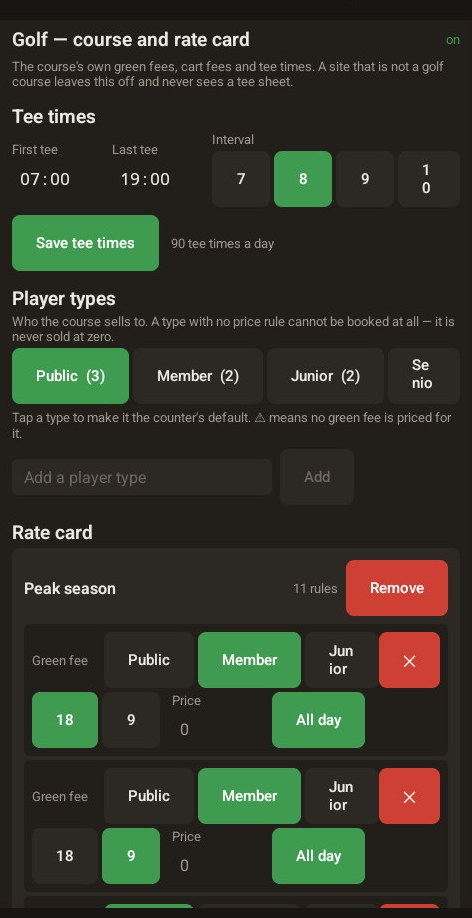
The course and rate card screen: first tee 07:00, last tee 19:00, an interval of eight minutes selected from seven, eight, nine and ten, four player types, and a Peak season rate card of eleven rules

The day is a setting, not a rebuild

First tee, last tee, and the interval — seven, eight, nine or ten minutes. The screen tells you what you just built: 90 tee times a day. Change the interval in October and the sheet re-renders; you do not delete the day and construct it again, and you do not call anybody to do it for you.

Underneath are the player types you actually sell to — Public, Member, Junior, Senior — and beside each one, the number of price rules that mention it. That count is a safety rail. A player type with no price rule cannot be booked at all. It is never quietly sold at zero, which is the usual way a season of junior rounds goes missing from the reporting.

The rate card itself is rules, not a price list: a green fee, for these player types, at 18 or 9 holes, at this price, all day or inside a time window. The demo course runs an eleven-rule Peak season card. Rules are what let one sheet price a member at dawn and a public twilight nine differently without a second system.

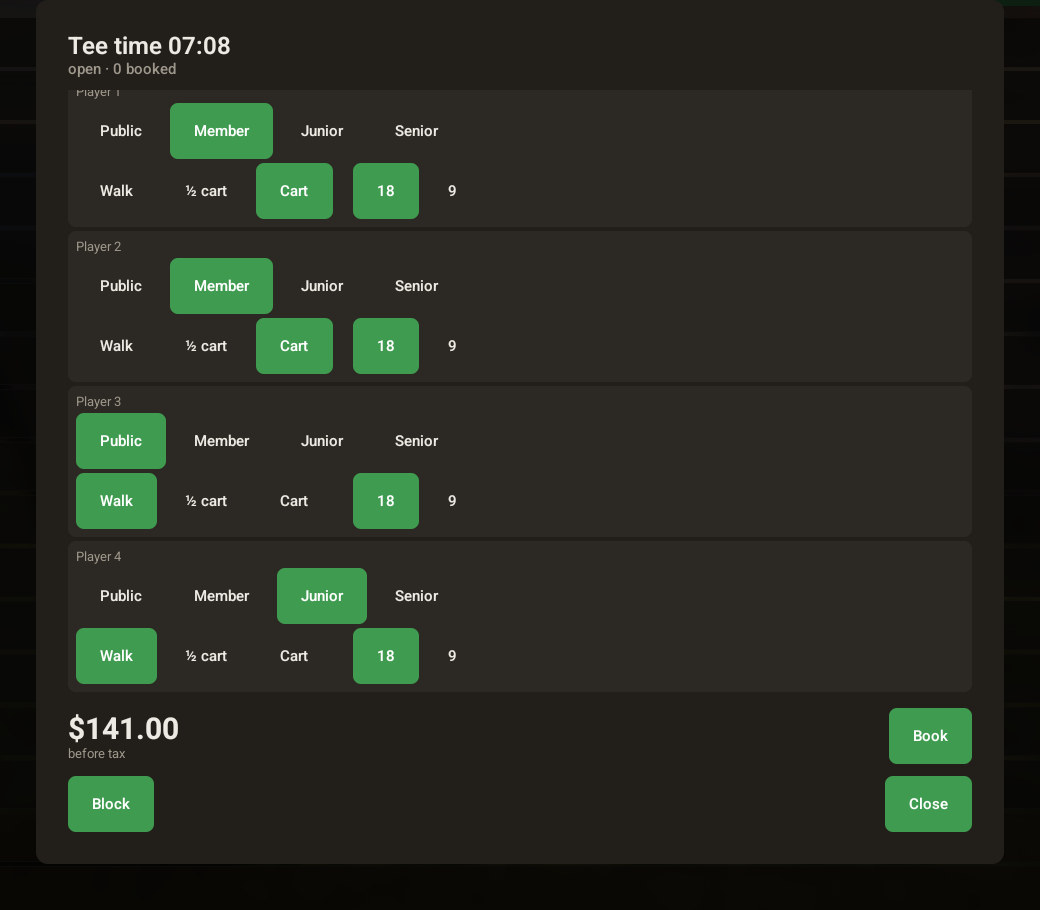
A tee time dialog for 07:08 with four players, each set to a player type, walking or riding, and eighteen or nine holes, totalling one hundred and forty-one dollars before tax

Four golfers, four prices, one tee time

Open 07:08 and you get the foursome, not a booking form. Each golfer carries their own player type, whether they are walking, taking a half cart or a full cart, and whether they are playing eighteen or nine. Here that is two members riding eighteen, a public walking eighteen, and a junior walking eighteen.

The total is $141.00 before tax, and it is arithmetic over four individually-priced golfers rather than a green fee times four with a discount applied afterwards. That matters later: when this group reaches the counter, splitting the check by seat is one tap, because every green fee and cart line already knows which golfer it belongs to.

Capacity is enforced on the tee time itself. A single and a threesome who booked separately fill one slot between them, and the fifth golfer is refused — with the next open times offered rather than an error. Block holds the time with a reason the starter reads off the screen, without touching the rest of the day.

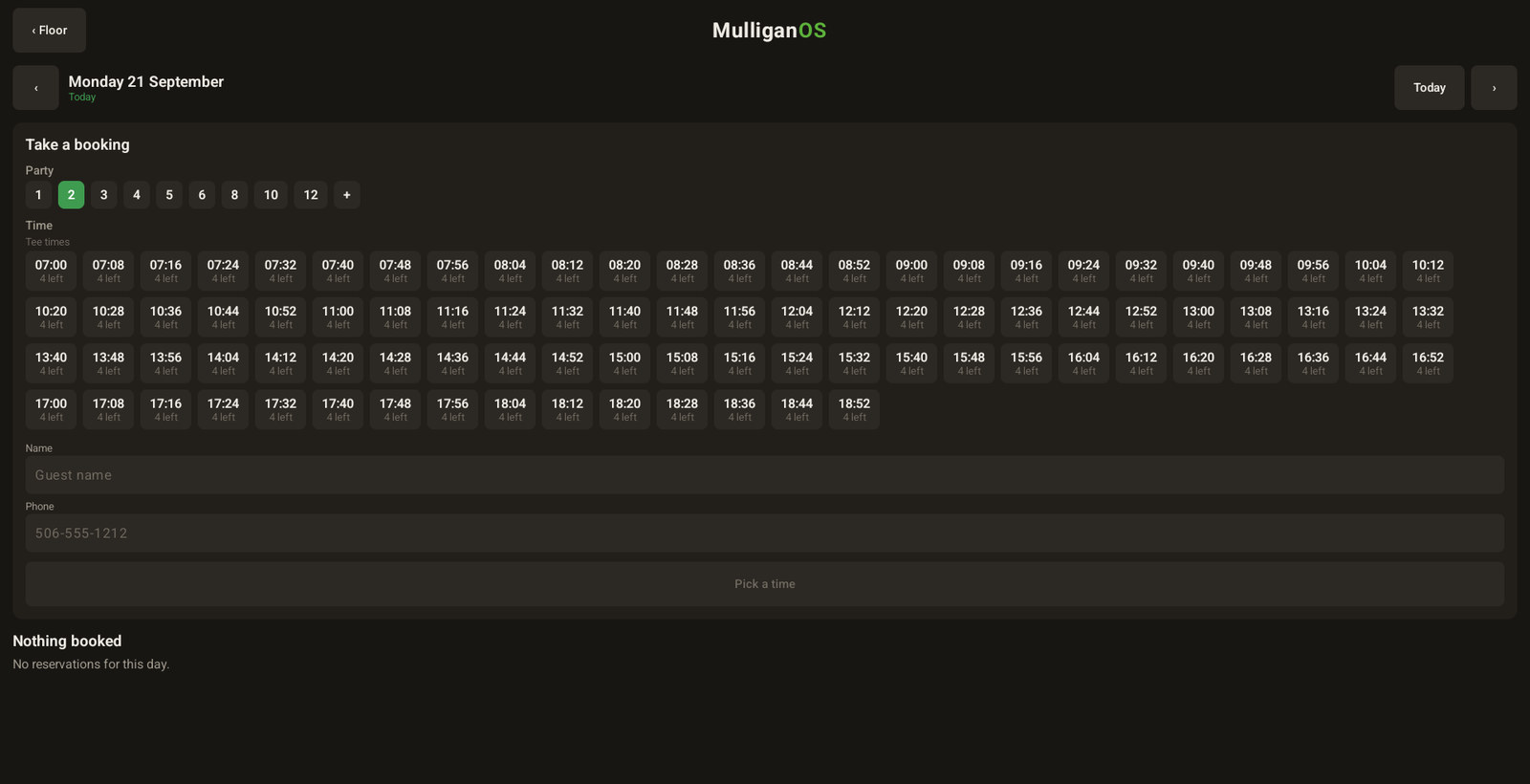
The take-a-booking screen: party size buttons from one to twelve, every tee time in the day shown with its remaining capacity, and name and phone fields

Taking a booking on the phone, at speed

Party size first, because that is the first thing a caller says. Then the whole day at once — every tee time, each with its real remaining capacity underneath it. You are not paging through a calendar while somebody waits; you are looking at ninety times and their availability on one screen.

Name and phone, pick a time, done. The same screen a starter uses for a walk-up is the one the shop uses for the phone, so there is no second tool to learn and no second place a booking can hide.

The small thing that matters daily

Every row says its condition in one word

A starter should be able to read the sheet across a counter without interpreting a colour or counting pills. Four words carry the whole state of a tee time.

  • open — nothing booked. The row still shows the price it would sell at right now, which is how you answer “what’s a round this morning?” without opening anything.
  • 3 left — partly booked, and the number is the actual remaining capacity, not a guess at whether a group will accept company.
  • full — four golfers are on it. At 07:08 above, the row also names who: Member, Member, Public, Junior.
  • gone — the time has passed. It stays on the sheet rather than disappearing, so the morning can still be reconciled at four o’clock.
  • An event name — a tournament holding times it has not released reads by name, like Fall Member-Guest. The day is not blocked out and it is not double-sold; the times are simply spoken for, and they say by what.
Two things worth knowing before you shortlist

What we built, and what we haven’t

The sheet does not need the internet

The tee sheet, the rate card and cash tendering are computed on the terminal in your pro shop. When the line drops — and in rural Atlantic Canada it drops — you keep booking, keep pricing and keep selling, and the day reconciles when the connection returns.

This is the part worth seeing rather than reading about. A demo includes pulling the network cable mid-sale.

Why that is built this way

Golfers cannot yet book this sheet themselves

Public online booking is on the roadmap, not shipping. Today the sheet is taken by your staff — at the counter, and on the phone using the screen above. If a self-serve booking page is a requirement for you this season, we are not the right answer yet and we would rather say so now than in month two.

When it ships, a golfer picking a time will be reading the same sheet the counter reads, so a slot cannot be sold twice and an online booking cannot quote a rate the shop would not honour. That is the reason it is not out yet.

Questions we get

Tee sheet software, answered plainly

What is a tee sheet management system?

It is the schedule of every tee time your course sells in a day, plus the rules that price them. A tee sheet management system decides the interval between tee times, enforces how many golfers fit on each one, holds times back for leagues and tournaments, and applies the right green fee to each golfer based on who they are and what they are playing. In a system like MulliganOS it is also the thing the till reads, so a round booked on the sheet arrives at the counter already priced.

Is there free tee sheet software?

There are free spreadsheets and printable golf tee sheet templates, and they work until two people write on them at once or a rate changes mid-season. The moment your sheet has to enforce capacity, price four different player types in one foursome, and reconcile against the till at the end of the day, a template stops being cheaper than software. We do not publish a price list — we quote your course — but there is no per-booking fee, so the sheet does not cost more as it gets busier.

Can I change the tee time interval mid-season?

Yes. The interval is a setting — seven, eight, nine or ten minutes — and changing it re-renders the sheet. You do not delete the day and rebuild it, and you do not need us to do it. The screen tells you how many tee times a day the new interval produces before you save it.

How does it handle members, juniors and seniors on the same tee time?

Each golfer on a tee time carries their own player type, cart choice and hole count, and is priced individually against the rate card. A foursome of two members riding eighteen, a public walking eighteen and a junior walking eighteen prices to one total — $141.00 before tax in the example above — built from four separate lines rather than one fee with a discount bolted on. Because each line knows its golfer, splitting the check by seat at the counter is one tap.

Does it keep working if the internet goes down?

Yes. The sheet, the pricing and cash tendering run on the terminal itself rather than in a browser talking to somebody else’s server, so an outage does not stop you booking or selling. This is a deliberate design choice and the main reason the product exists in the form it does.

Can golfers book online?

Not yet — public online booking is on our roadmap and we mark it that way everywhere on this site rather than implying otherwise. Staff take bookings at the counter and by phone today. We would rather lose a shortlist over this than win one and disappoint you in month two.

Next

The rest of the system

The tee sheet is one of ten things a course runs on. It is worth seeing what sits behind it.

See it

Book a demo

We will show you the running system on a real terminal — including pulling the network cable mid-sale, which is the part worth seeing.

RKP Atlantic Business Services · New Brunswick, Canada
Request a demo