MulliganOS — The Operating System for Your Golf Course

A tee sheet and point of sale built for the pro shop counter — one system for the sheet, the shop and the grill. It runs on hardware you own, it keeps taking money when the internet drops, and it never tells you which payment processor you have to use.

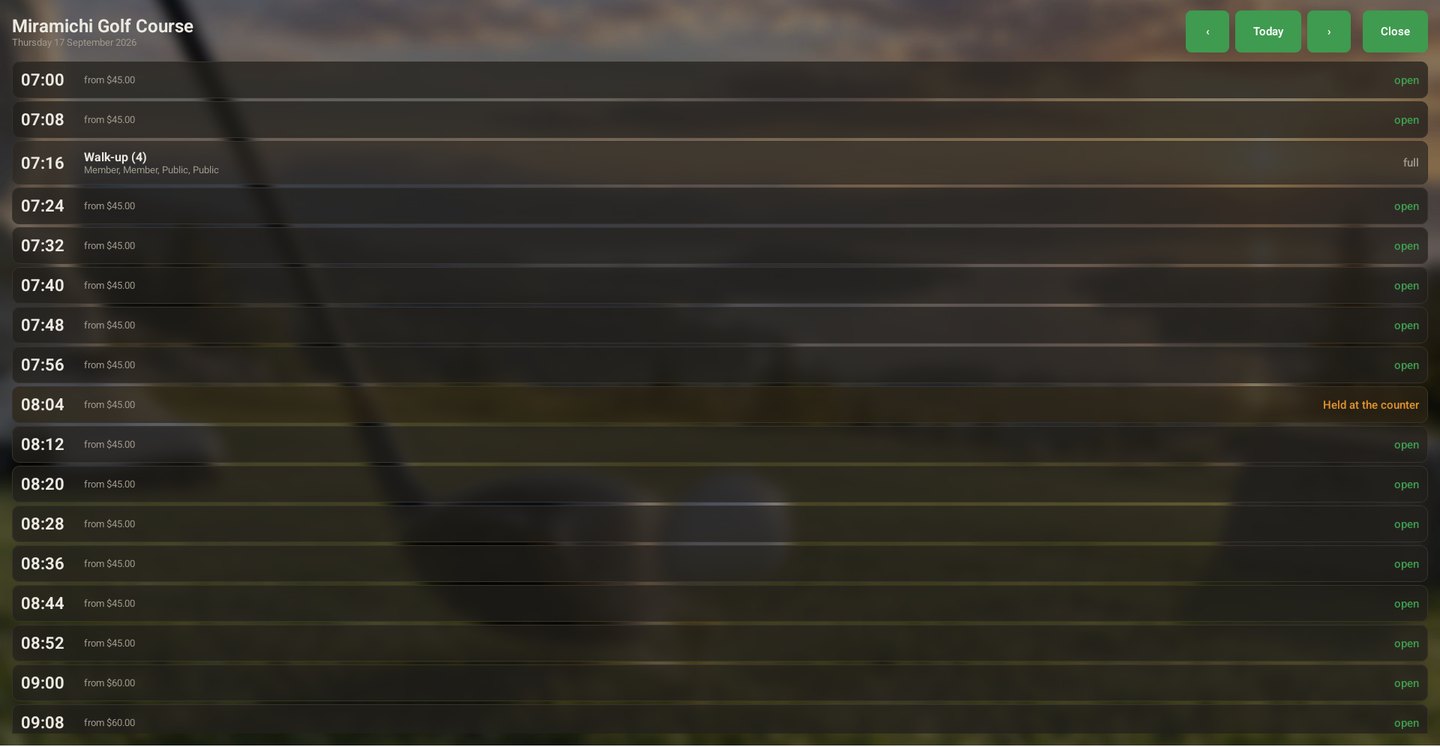
The MulliganOS tee sheet showing eight-minute tee times, a booked foursome, a blocked slot and the morning rate

The real tee sheet, running on the terminal. Eight-minute tee times, a booked foursome, a tee time held at the counter, and the morning rate switching at nine o'clock.

What it does

Ten things a course runs on

We mark honestly what is shipping today, what is partly built, and what is on the roadmap. You should be able to tell the difference before you talk to us, not after.

Tee Sheet Shipping

The day's tee times at any interval you run — eight minutes, nine, or an alternating eight-and-nine. Foursome capacity is enforced per tee time, so a single and a threesome booked separately fill one slot and the fifth golfer is refused with the next open times offered.

Individual tee times can be held back with a reason the starter reads off the screen ("Men's league"), or re-sized to a twosome, without touching the rest of the day. Every row states its condition in a word: open, 3 left, full, gone.

Changing the interval re-renders the sheet. It does not require deleting and rebuilding the day.

POS Shipping

A full touchscreen till: order entry, seats, modifiers, discounts and comps with manager approval, voids with an audit trail, cash drawer shifts with X and Z reports, and end-of-day reconciliation.

Split a check evenly, by seat, or by item — the parts always add up to the whole to the cent, including the tax, which is allocated rather than recalculated.

Pro Shop Partly built

The till rings shop items, takes payment and reports on them today. What is not built is stock: there are no quantity-on-hand levels, no receiving, no counts and no reorder points.

You can sell a glove today. The system will not tell you that you are down to three.

Restaurant Shipping

The most mature part of the system, because it came first. Floor plan and table status, a reservation book with a capacity guard, per-table service timing alerts, a kitchen display, and separate kitchen and bar printer routing so drinks and food print where they are made.

The clubhouse grill and the halfway house run on the same till as the sheet — one system, one end-of-day.

Memberships Roadmap

Not built. Today a member is a rate: you define a Member player type, give it its own green fee — including zero, if dues cover the round — and the sheet prices it correctly.

What is coming is the record behind the rate: member accounts, dues billing, house-account balances and statements. This is the next module in development.

Tournaments Roadmap

Not built. You can hold back a block of tee times for a league or an event today, with a reason on each, which covers a shotgun in practice but not on paper.

Planned: an events module with field management, formats, recurrence, and a hole-axis sheet for a true shotgun start.

Inventory Roadmap

Not built, and deliberately not next. Deep retail inventory — purchase orders, supplier catalogues, landed cost — is where the incumbents are genuinely strong, and we would rather be honest about that than ship a thin imitation.

We will build it when a course tells us it is the thing standing in the way.

Payments Partly built

The payment layer is an abstraction, not a lock: the till talks to a processor interface, and adapters plug in behind it. That is the architecture that lets you keep your own merchant account.

Card processing is not live yet. A simulator is used for development, one processor adapter is written but not yet certified, and card-present terminal integration is in progress. Cash, house accounts and split tenders work today. We will not tell you cards are ready before they are.

Online Booking Roadmap

Not built, and gated on card processing for a good reason: a public booking page is close to useless without the ability to hold a card against a no-show, and we are not shipping one that cannot.

The availability engine that would serve it is already built and tested, so the booking page is a surface on top of finished arithmetic rather than a new system.

Reporting Partly built

Shipping today: cash drawer shifts, X and Z reports, drawer reconciliation with over/short, discount and void audit trails, and per-staff accountability on every transaction.

Planned: rounds played, green-fee revenue by rate and by day, sales by category and by staff, and a season view.

The actual software

Screens from the running system

These are captures of the real build on a real terminal — not mockups, not renders.

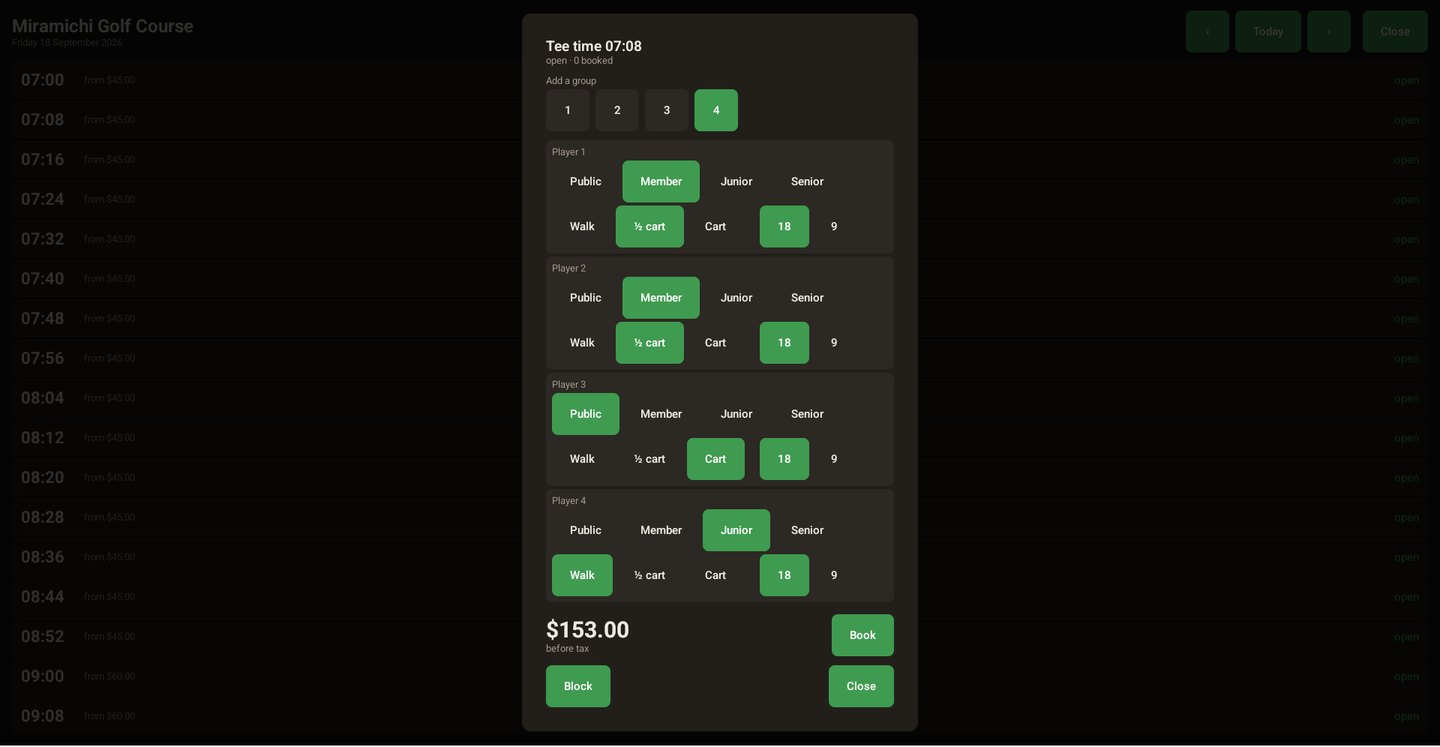
Price a group before you commit to it

Build the group at the counter — who is a member, who is a guest, who is walking and who is riding — and the total updates as you tap.

Here two members ride a shared cart at no green fee because their dues cover it, a public golfer pays the morning rate plus a single cart, and a junior walks. The counter sees $153.00 before anyone has committed to anything.

Building a mixed foursome with live pricing totalling $153.00

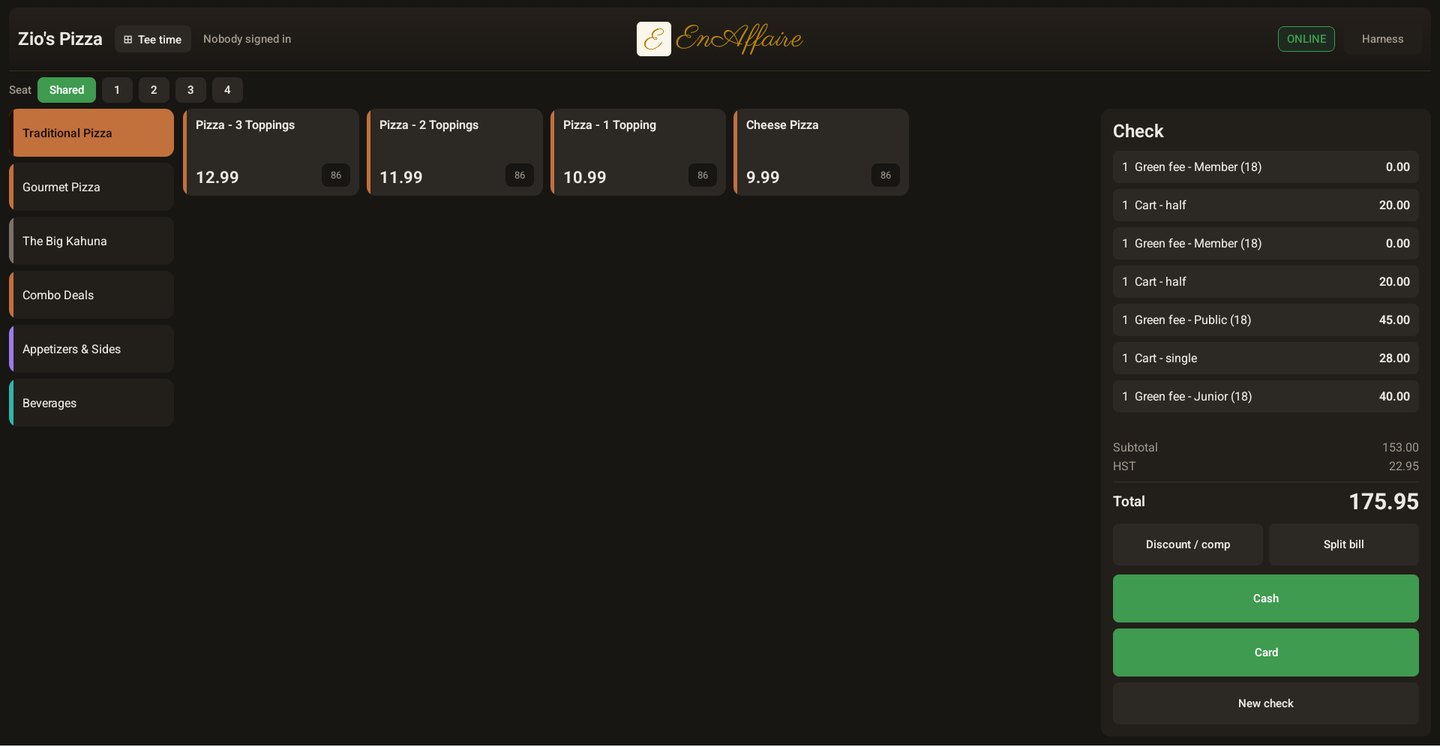
Check-in opens a real check

Checking a group in puts one green fee line — and a cart line for anyone riding — on the till, seated one per golfer. Tax is applied once on the whole, not per line.

Nothing is re-keyed. The sheet and the till are the same system.

The till showing per-golfer green fee and cart lines with HST and a total

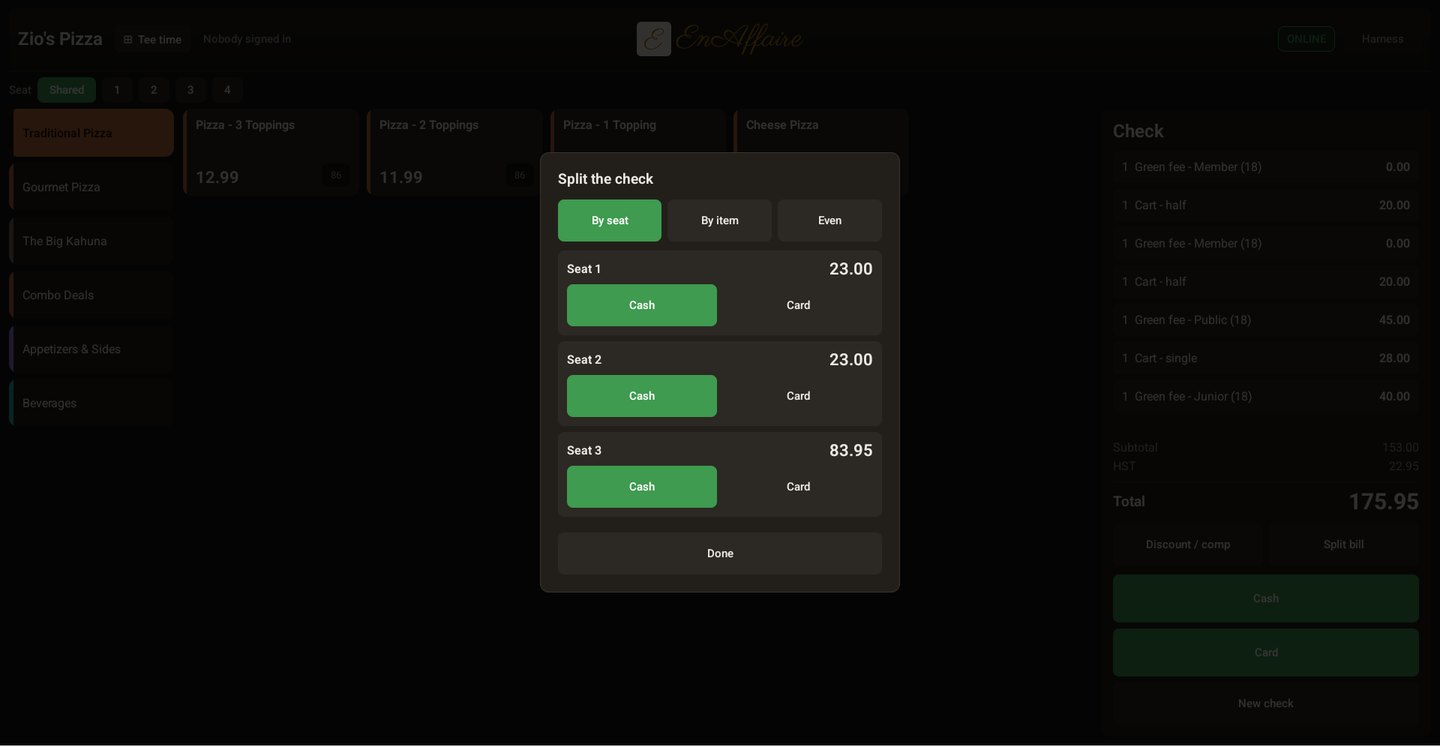
Split the foursome in one tap

The single most common transaction at a pro shop counter. Because each golfer is already a seat on the check, splitting it is one button — and the four parts add up to the total exactly, tax included.

The check split by seat into four amounts that sum to the total

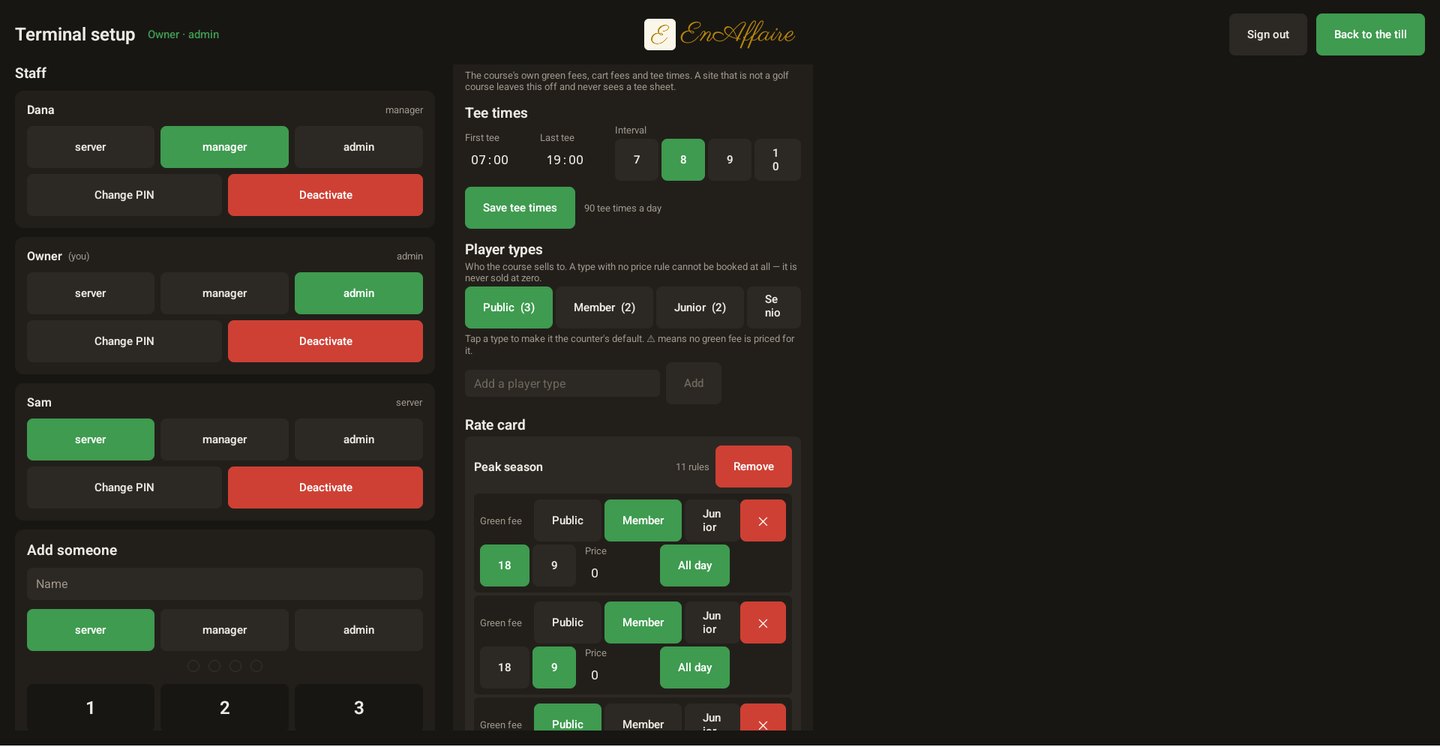
Your rates, typed in by you

Green fees and cart fees by player type, by hole count, by cart kind, with optional time windows for a morning or twilight rate. Seasonal cards you can clone and assign to the days they apply to.

A player type with no price cannot be booked at all — it is never quietly sold at zero. The screen tells you which types are unpriced before a golfer finds out.

The rate card editor showing tee times, player types and editable price rules
Straight comparison

MulliganOS vs Lightspeed Golf

Lightspeed Golf is the market leader and it is a good product — its customers rate it highly, and we are not going to pretend otherwise. There are specific, checkable places where we are built differently. Every claim below is sourced; where something is second-hand we say so.

Lightspeed GolfMulliganOS
When the internet drops A hosted service. Lightspeed publishes a status page for Tee Sheets and support guidance on what to do during an outage. For its restaurant product it documents no true offline mode — only a "standalone" card path where, in its own words, "payments received in standalone mode do not generate a receipt ID" and the sale must be re-entered by hand. Golf-specific offline behaviour is not publicly documented. Local-first by design. The tee sheet, pricing, order entry and cash tendering are computed on the terminal from local data and a local event journal. The sheet does not need our servers to be up to sell a tee time.
Your payment processor Requiring a card at online booking is gated on their own gateway. Their documentation states plainly: "Lightspeed Payments Golf (card not present) gateway is required to utilize this feature." The processor sits behind an adapter interface. Keep your merchant account and your rate. (Card processing is not live yet — see Payments above.)
Changing your tee time interval Tee times are stored rows created in bulk. Their documentation: "It is necessary to delete all tee times and re-create them in order to adjust tee time intervals." Tee times are computed from the interval. Change it and the sheet re-renders. Nothing is deleted.
Pace of play A manual stopwatch. Enable a toggle and staff "record the start and stop times for the selected tee time." Not built yet — and we are not going to call a stopwatch a feature. The timestamped service-stage machinery it would use already exists on the restaurant side.
Dynamic pricing Available, and off by default. Note their own documented limitation: tee times affected by dynamic pricing templates are not compatible with Reserve with Google — the yield tool and the free demand channel are mutually exclusive. Not built. Rate cards with time windows cover morning and twilight pricing. If we add a demand layer it will sit over a price that stays quotable.
Price No price is published on their own pricing page — it directs you to a quote. Third-party reviews widely report a starting point of about US$325/month, plus add-ons. Treat that as reported, not official. Contact us. We would rather quote your course honestly than post a number that turns into a different one.
Contract Their golf pricing page states "No Long-Term Contract" and that you can cancel at any time. Their general Service Agreement contains auto-renewal and early-termination terms. We could not confirm from public sources which governs a golf order — ask for the Order Form and read it. No term lock. Hardware is yours.
Where it's strong Genuinely: deep retail inventory, a mature member and event module, multi-course reporting, a well-run partner API, and a large support organisation. Its customers rate it well. We are earlier. Memberships, tournaments and inventory are roadmap. If those are what you need on day one, they are the better fit today.
On outages: we make no claim about any specific Lightspeed incident. What we say is architectural and checkable — a cloud tee sheet depends on a link to a data centre, and ours does not.

Sources: Lightspeed Golf support documentation (creating tee times; tracking pace of play; configuring mandatory credit cards for reservations; using dynamic pricing templates; Reserve with Google), the Lightspeed Golf pricing page, the Lightspeed Service Agreement, Lightspeed Restaurant K-Series standalone-mode documentation, and third-party reviews for reported pricing. Checked September 2026.

Pricing

We'll quote your course

We are not publishing a price list yet, and we would rather say that than invent one.

  • No per-booking fee. We do not take a cut of your tee times.
  • No forced processor. Keep your merchant account and your rate.
  • You own the hardware. No clawback if you leave.
  • No long-term lock.
Ask for a quote
See it

Book a demo

We will show you the running system on a real terminal — including pulling the network cable mid-sale, which is the part worth seeing.

Email: [email protected]
RKP Atlantic Business Services · New Brunswick, Canada

Request a demo